The SNA board met last week and would like to hold a virtual meeting to discuss this year’s participatory budgeting opportunity. The SNA has had great success in getting sufficient community votes that have resulted in funding for several improvement projects that have benefited our neighborhood in year’s past–and with your help we would like to keep this winning streak going strong in 2025!
Meeting objectives are:
Discuss potential projects for SNA to sponsor (only one proposal can be submitted per group/author);
Agree on the process for the project to sponsor, and
Discuss whether SNA-associated groups (e.g., Slow Hearst, Detroit Steps) plan to submit project(s) individually.
At a follow-on meeting, to be held at a mutually-convenient time, we will:
Agree on the project for SNA to sponsor,
Determine the proposal writer and editor for SNA’s proposal (due date is March 28), and
Discuss promotions strategy to get project(s) over the 400-vote minimum threshold for funding.
The SNA held it’s quarterly general meeting last Monday. Here’s a recap of what went down.
Supervisor Myrna Melgar updated us about the current Muni financial crises and ongoing negotiations about possible cutbacks in transit service. Read more about it and give your feedback here. Also, this year’s Participatory Budgeting is kicking off. If you have an idea for a project for the neighborhood submit it here.
Ingleside Station Captain Amy Hurwitz spoke about the general down tick in crime in our area and invited everyone to the SFPD Ingleside Community Meetings held third Tuesdays of the month, 6-7 PM at Ingleside Station Balboa Park. For latest details, call the Ingleside Station at 415-404-4009; email SFPDInglesideStation@sfpdgov.org; anonymous tip line: 415-587-8984 Fax 415-404- 4008.
She also alerted us about the new speed cameras that are slated to be installed on Monterey Blvd between Edna and Congo in March or April.
Estelle Smith gave a report on her efforts to improve Havelock Street and the 1-280 footbridge connecting to Balboa Park. If you haven’t already read her post check it out here.
Cooper Smith from Quit Carbon gave a presentation. QuitCarbon helps homeowners upgrade their homes with clean energy by providing them with a free home assessment, a personalized upgrade plan, and a network of trusted contractors to replace gas furnaces, water heaters, and stoves, windows, insulation and more. They also provides homeowners with free expert guidance on their project, from start to finish.
Secretary Margaret Hosel spoke about proposed changes to the SNA by-laws. They will be posted soon and voted on at the next quarterly meeting in May.
And finally, we elected Mike Kelly as our second Member at Large for the SNA Board. Welcome, Mike!
It’s that time again! The Sunnyside Neighborhood Association Board is having our casual coffee meetup at the local coffee joint, the Railroad Expresso, this Saturday 2/22/2024, from 9 to 10am. Gotta gripe? Maybe an interesting project you’d like to do with the SNA? Swing by for some java and meet your board and your neighbors and share your thoughts! Let’s make our community even sunnier together!
The Havelock Street Pedestrian Bridge in San Francisco serves as a link between the Sunnyside and Balboa Park neighborhoods. This bridge is more than just a crossing; it’s a testament to community resilience and collaboration. Spanning Interstate 280, it provides a convenient route to Balboa BART station on the east side and to City College of San Francisco (CCSF) on the west side.
In the early 20th century, the area surrounding Havelock Street was a burgeoning community hub. Photographs from 1910 depict Havelock Street bustling with activity, highlighting its significance in connecting residents across the then-developing regions of San Francisco. In the mid part of the same century, Interstate 280 split the east and west side of Havelock Street in half, thus giving rise to the Havelock Street Pedestrian Bridge.
The bridge faces challenges common to urban infrastructure, including neglect and vandalism. Once a proud passageway, the Havelock Street Pedestrian Bridge stood tall, alive with footsteps and laughter. But tireless sculptor of time has worn it down. Paint peeled like sunburnt skin, rust crept in like old regret, overbearing growth of ivy, and taggers claimed its pavement and lampposts, layering names in fading defiance. Once a ribbon of cement, steel and promise, the bridge now sags under years of neglect, whispering to the sounds of passing cars below, longing to matter again. By the 21st century, the once-vibrant bridge had become a canvas for graffiti and a repository for litter, diminishing its appeal and safety.
Current view of the bridge, facing east.
Coordinating the Havelock Street Pedestrian Bridge beautification demands navigating a maze of bureaucracy across multiple government entities. The bridge, owned by the state (Caltrans), maintained by San Francisco, and spanning a federal highway, creates jurisdictional complexity. Any modification requires assistance from Caltrans, BART, federal and city agencies, each enforcing its own regulations, safety codes, and review timelines. This adds to layers of red tape, making updates a challenge. Balancing competing priorities among these entities makes consensus difficult, turning even minor tasks into coordinated negotiations. Despite these challenges, persistent community advocacy and strategic collaboration continue to push the project forward.
The Havelock Street Pedestrian Bridge, long a quiet fixture of the neighborhood, is now the canvas for a community determined to bring it back to life. With a splash of color, a touch of care, and the collective will of neighbors who refuse to see beauty surrender to rust, the old crossing gets a second act, proof that San Francisco’s heart still beats in unexpected places.
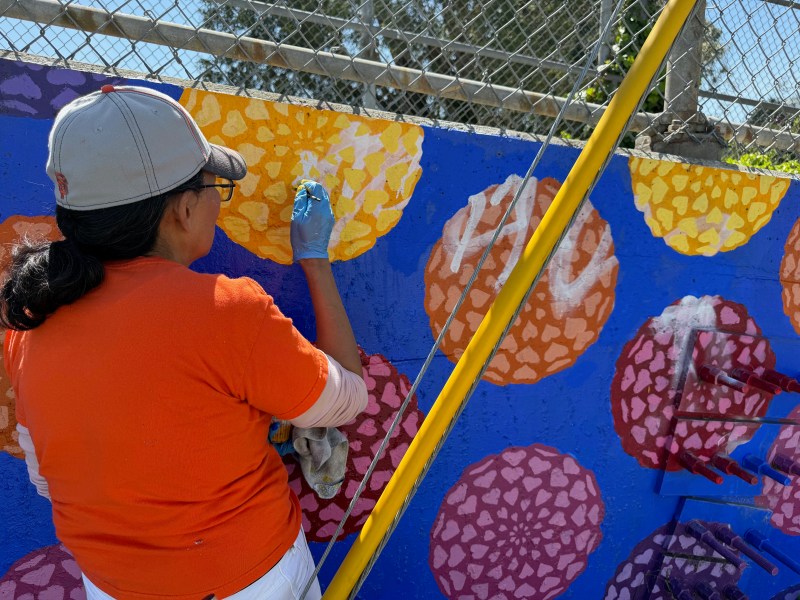
The initial revitalization effort started with a vibrant 40-foot mural adorning the bridge’s west entrance. Inspired by San Francisco’s official flower, the dahlia, the mural features heart-shaped petals in warm hues, symbolizing kindness and community warmth. Beyond its aesthetic appeal, the mural enhances safety by signaling an active and cared-for space, deterring vandalism and promoting pedestrian use.
Picture courtesy of Anne Marie Kristoff/Ingleside Light
The Havelock Bridge has taken its first breath of renewal, but the work is far from over. There is a budget-approved sidewalk on the south side of Havelock Street (near CCSF’s tennis courts). But, imagine more transformation, new fencing standing strong against time, warm lighting casting a welcoming glow, and the vibrant dahlia mural stretching across the pavement, turning every step into a walk-through art. The east side, long shadowed by neglect, will see its graffiti scrubbed away, giving space that feels cared for and claimed by the community, not by decay. With each improvement, the bridge becomes more than a crossing, it becomes a statement, a symbol of what’s possible when a city refuses to let its beauty fade.
The Havelock Street Pedestrian Bridge is on its way to becoming a vibrant, welcoming crossing, but it needs you. Contact your elected officials and ask them to support revitalization efforts for the Havelock Street Pedestrian Bridge. Join upcoming volunteer cleanup days and help restore this community landmark, email havelockbridgesf@gmail.com to join the Friends of Havelock Street Pedestrian Bridge. If there is something that needs attention on the bridge, report it to SF311. Every voice, every effort, and every small act of care makes a difference in bridging the past and revitalizing the future, one step at a time.