
Cal Voices / Cal Hope support line

Although for many the Covid-19 pandemic is now creating less stress and difficulty in everyday life, for some there are still effects that continue to impact mental and emotional health. There is a network still available through the State that can help provide support and counselling assistance, and they invite you to call or connect via their website.

Cal Voices Crisis Counseling Assistance and Training Program (CCP) is a part of a network of organizations and individuals that are being trained to provide virtual support to Californians experiencing stress, anxiety, and/or trauma because of COVID-19.

Peer Crisis Counselors assist individuals and communities in recovering from the effects of COVID-19 by assisting Californians in understanding their current situation and reactions, mitigating stress, developing coping strategies, providing emotional support, and encouraging linkages to resources and longer term supportive services.

The flyer below has information about a telephone “warm line” that people can call if they are struggling due to COVID-19, as well as a link to our Live Chat feature where people can talk to Peer Crisis Counselors by chat. Although Cal Voices is based in Sacramento, many of us Peer Crisis Counselors work remotely throughout California.

Cal Voices line: 916-288-8535

https://www.calhopeconnect.org/

Continue reading “Cal Voices / Cal Hope support line”
Traffic Calming proposed for Joost and Mangels

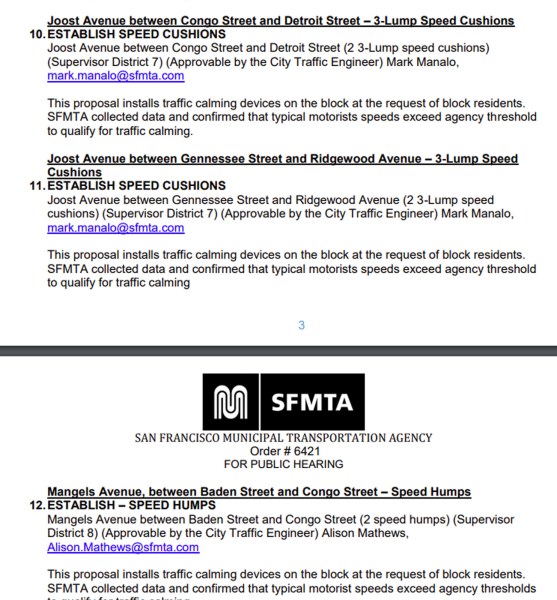
At the June 4, 2021, SFMTA Engineering Hearing: Speed cushions are proposed on Joost Ave between Congo/Detroit and Gennessee/Ridgewood) and for Mangels Ave. (between Baden/Congo). More about the meeting here. Agenda here (pdf).

Residents wishing to request traffic calming for their block can find out more here. Deadline for this cycle closes in just one week, on June 30, 2021. Currently the petition requirement is being waived.

https://www.sfmta.com/sites/default/files/reports-and-documents/2021/06/ph_7_2_2021.pdf

Business is Blossoming on the Boulevard

With the arrival of Yellow Tier guidelines for San Francisco, businesses on Monterey Blvd are getting close to pre-Covid operations. If you’re feeling more confident these days, consider patronizing our local restaurants, salons, barbershops, cafés, or other businesses.

All but one of the restaurants listed before are open for indoor dining now, though at reduced capacity. Our many local personal service businesses can now operate at full capacity, such as salons, barbers, and spas. There are no restrictions in retail stores except the requirement for masks.


Continue reading “Business is Blossoming on the Boulevard”

Virtual Office Hours with D7 Supervisor Melgar on April 16

Join District 7 Supervisor Myrna Melgar for her new regular office hours on Friday April 16th, 1:00 – 3:00 PM. From Supervisor Melgar and her Office Staff:

We will be holding monthly live office hours using Zoom . Our first one is on Friday April 16th. Come meet the new Supervisor and her staff and we will assist you with any issue you’d like to discuss.

You can book a 10 min appointments using this link below. Drop-ins are also welcome but you may have to wait an unknown amount of time.

Book here: https://outlook.office365.com/owa/calendar/DIstrict7@sfgov.microsoftonline.com/bookings/s/1-Mf0byKxkCHv1Oc6OpEtA2

If you cannot make this month’s office hours, you can always email us at melgar.staff@sfgov.org for our assistance or leave a phone message (415) 554-6516. We are all working remotely, so please be patient if expecting a call back.

To report issues that the city should address, please use the 311 system and it will be routed to the appropriate department.”

Slow Streets for Hearst Ave approved by SFMTA

On Tuesday, SFMTA had officially approved the implementation of the Slow Streets program on Hearst Avenue in Sunnyside, along with streets in SoMa, Inner Sunset, and the Western Addition. The designated blocks for Hearst will run from Baden Street to Ridgewood Ave.

This program prohibits vehicle through-traffic in order to make space for walking and cycling in the street as needed for socially distanced outdoor exercise — but it does not restrict families dropping off students at local schools, or residents coming and going from their home, or vehicles making deliveries. The success of the program will be assessed after it has been in place for a while, as with all the streets in the Slow Streets program.

Media: