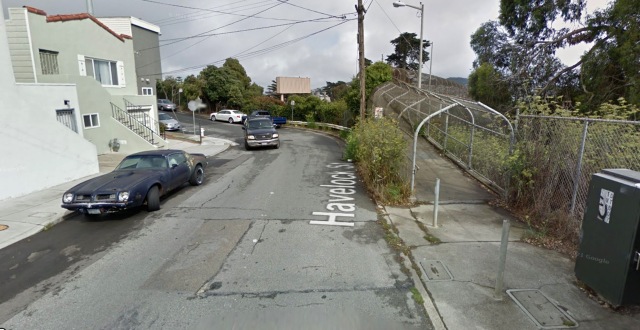
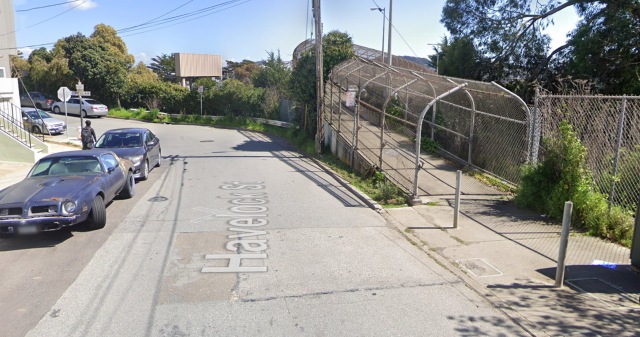
Let’s take a walk through the Sunnyside neighborhood in San Francisco. Head south on Edna Street where it meets Havelock. Straight ahead you’ll see the lush green bushes and the fence for the City College tennis courts. Now look left, and there it is—the Havelock Street Bridge—the main pathway over the freeway, connecting Sunnyside to the wide green lawns, playgrounds, off-leash dog park, swimming pool, and other facilities at Balboa Park in District 11.
What comes to mind is, how does one safely cross? There is no crosswalk to access the bridge and no sidewalk on the south side of Havelock Street. Peering even farther left, at the corner of Circular Avenue, cars and bicycles treat this intersection as a quick yield. With no other traffic entering from the east, cars typically roll through the intersection, even though there is a stop sign.
Intersection of Havelock and Circular, entrance to the Havelock Street Bridge.
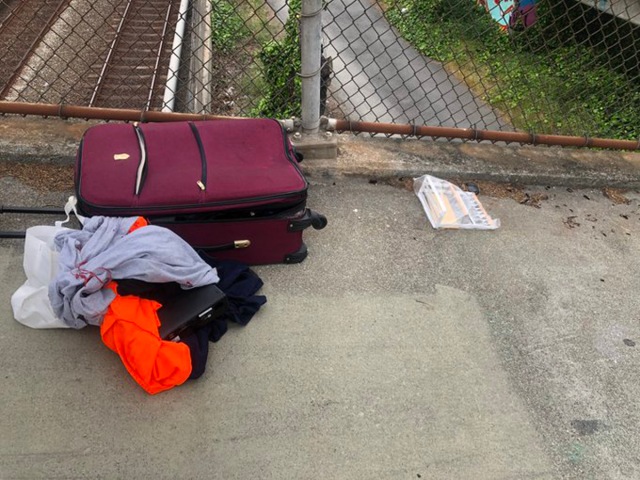
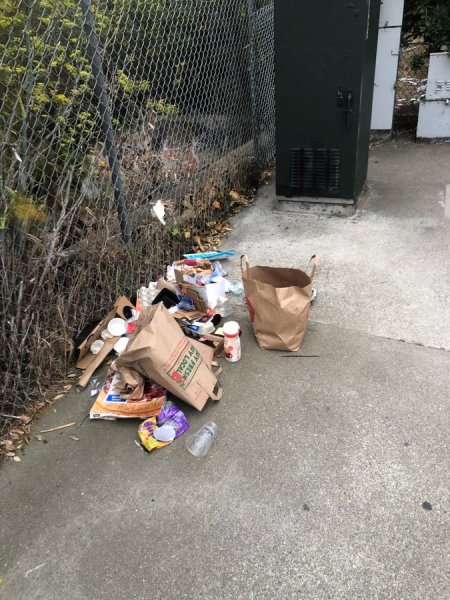
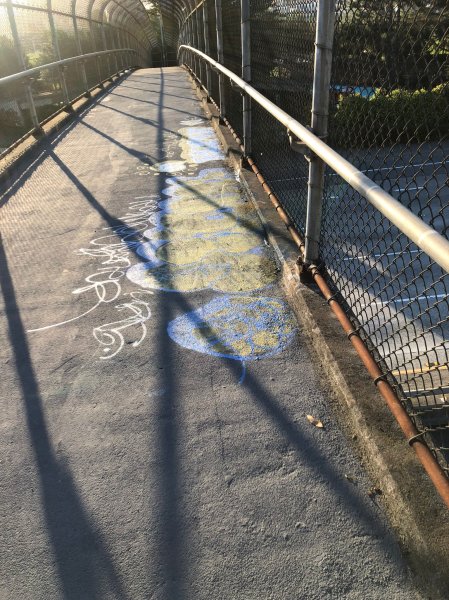
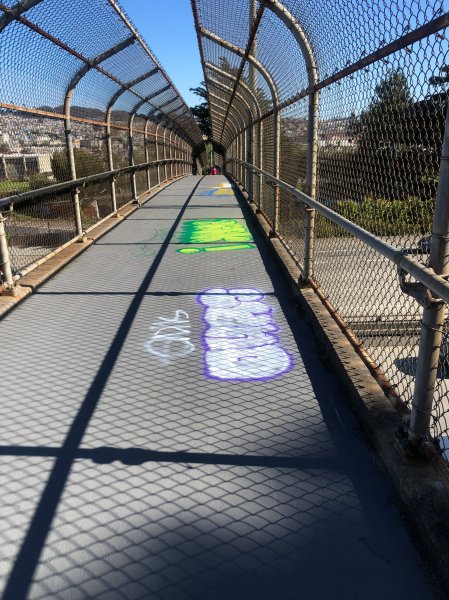
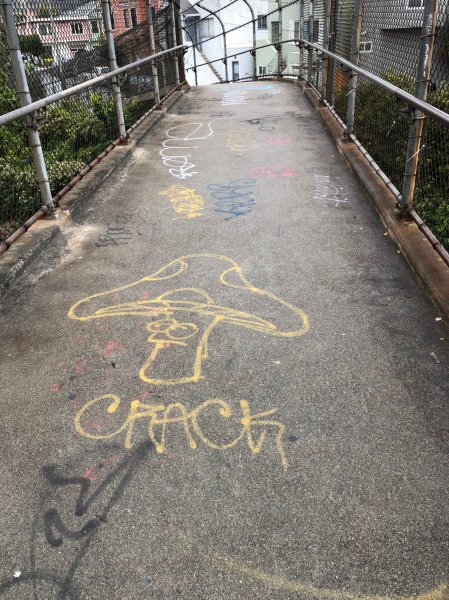
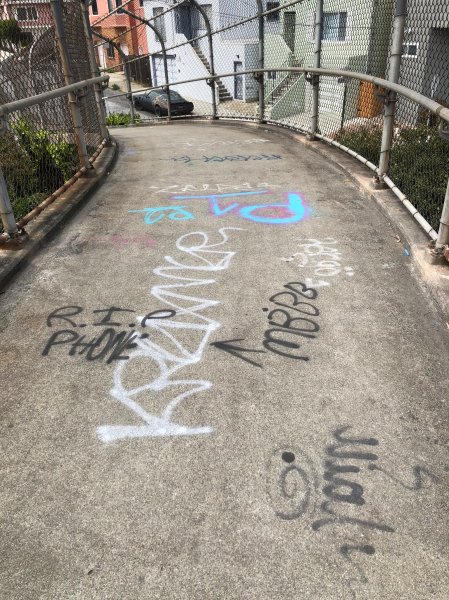
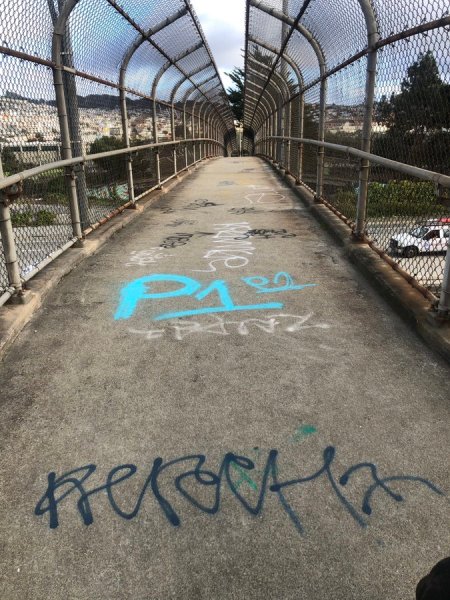
Once across the street and on the bridge, something else becomes visibly apparent. This bridge is ugly. It is riddled in graffiti and discarded litter ranging from broken glass to dirty diapers. This concrete jungle pathway, connecting two oases, is an eye sore and doesn’t reflect the warmth and beauty of the Sunnyside and Mission Terrace neighborhoods, or the wonderful park on the other side.
Havelock Bridge. Photo: Estelle Smith
Havelock Bridge. Photo: Estelle Smith
Havelock Bridge. Photo: Estelle Smith
Havelock Bridge. Photo: Estelle Smith
Havelock Bridge. Photo: Estelle Smith
Havelock Bridge. Photo: Estelle Smith
Havelock Bridge. Photo: Estelle Smith
Why? Why is there no crosswalk? Why is the bridge repeatedly vandalized? This is the crux of this article. All bureaucratic roads lead back to here. So, let’s start with how we got here and how we can move forward.
By Amy O’Hair, SNA Secretary and past member of the Balboa Reservoir Community Advisory Committee
Last month, the Balboa Reservoir Project development team presented revised plans for the central park at an open house at Unity Plaza. The presentation demonstrates that concerns and preferences of Sunnyside residents have been addressed by some of the revisions–items which were previously identified in a survey conducted by Sunnyside Neighborhood Association (SNA) as well as issues raised at the Nov 2020 meeting of the Balboa Reservoir Community Advisory Committee (BRCAC).
When initial plans were presented at the November 2020 meeting of the BRCAC, objections were made from several attendees and committee members to the compartmentalized nature of the park space as presented. The community garden had high fences that visually cut up the open space; an orchard was included, which would also need high fencing to prevent theft. It was suggested that the proposed pavilion could accommodate events or small-scale performance programs.
Following that, in Nov-Dec 2020, SNA conducted a survey of local residents about the uses they made of existing parks, as well as things they would like to see included in the Balboa Reservoir Project central park. Half of respondents lived in families with children. Basic activities like walking, sitting, and doing things with children were most important for respondents. Features that respondents said they valued in parks included playgrounds, benches, and picnic tables. Top landscaping desires included trees and open grassy lawns, with native plants, flowers, and shady areas coming next. The full results of that survey can be found here (PDF).
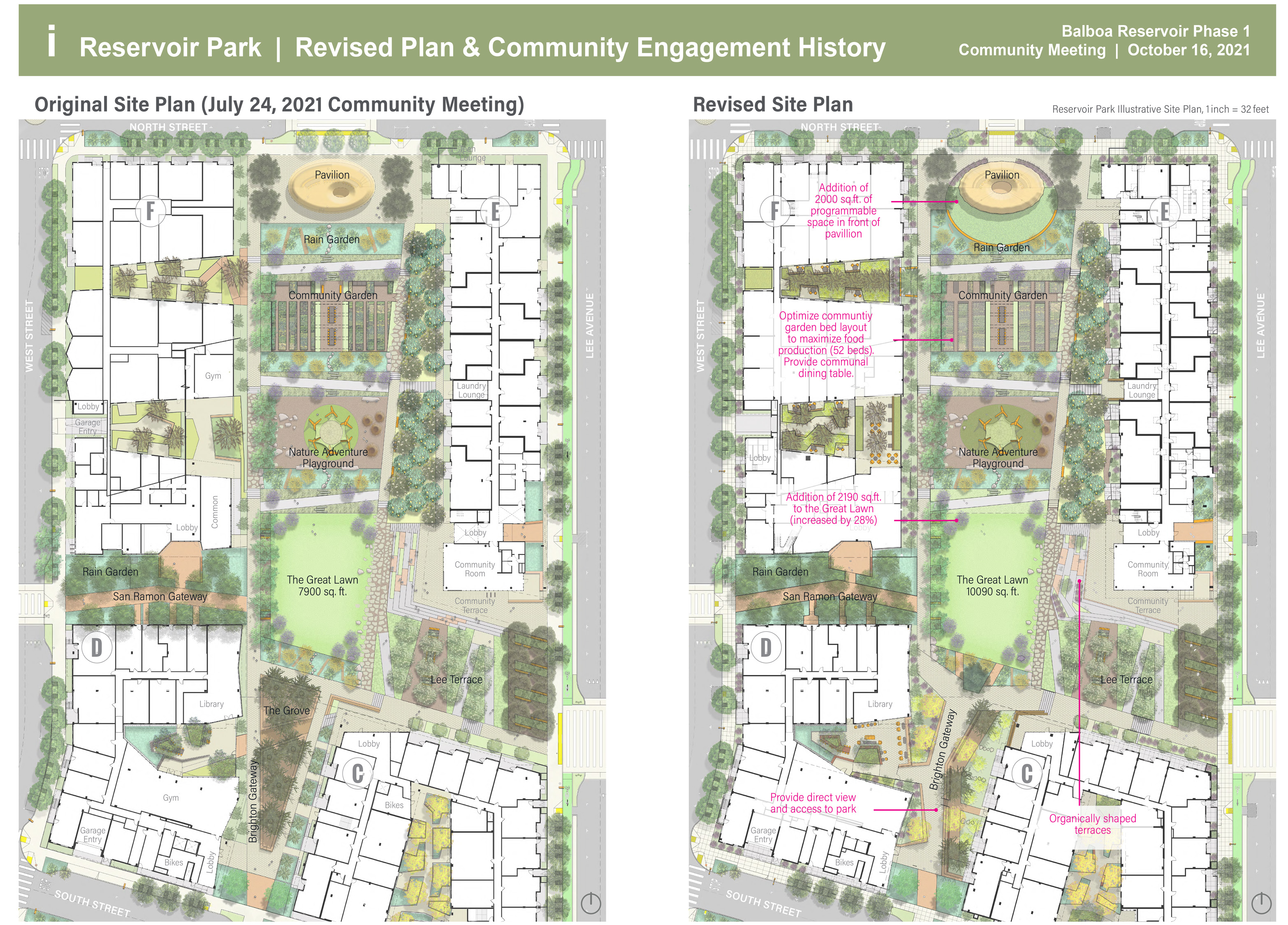
The revised plans presented in October show changes that address some of the issues raised over the last year by Sunnyside residents. The open grassy lawn area has been enlarged by 28%; the community garden fences shown in the presentation are more transparent to the eye, being an open mesh topped with wood. There are numerous places where benches, picnic tables, and other public park ‘furniture’ have been included, providing spaces for families or friends to gather or share meals. The plans show many trees for the open spaces, creating shaded areas. The Pavilion now includes some space around it that could be used to accommodate events.
The Balboa Reservoir Project has been controversial for some local residents; no one can deny that looming traffic and transit issues remain unresolved to date. Nonetheless, the developer team at AvalonBay/BRIDGE working on the open space portion of the project is to be congratulated for their responsiveness to the stated needs of the current local residents who plan to use the planned Reservoir Park. If all goes well, Sunnysiders can look forward to enjoying a unique and lovely new park nearby.
Below are the ten slides for the presentation boards from the Balboa Reservoir Open House on Oct 16, 2021. Give your feedback regarding these park plans by email: balboareservoir@gmail.com . Get updates from the developer by signing up here.
The developer team for the Balboa Reservoir Project is hosting an outdoor open house meeting for the community to designs for the Reservoir Park that will be at the center of the housing development.
Developers BRIDGE Housing and AvalonBay Communities are co-hosting this outdoor open house, focused on Balboa Reservoir Park. All interested community members are invited. This meeting is intended as a follow up from the July 24th meeting. Attendees can hear directly from the landscape design team about these changes give feedback.
Sunnyside’s local Detroit Steps Project is well on its way to success. the most recent good news is that San Francisco Parks Alliance (SFPA) has just approved the Project’s application to become one of the organization’s fiscally sponsored community groups.
This new community connection means that the Detroit Steps Project (DSP) will have additional resources to put toward its efforts to secure a Community Challenge Grant (CCG), the City-sponsored funding that has made possible many similar projects in neighborhoods over the years.
SFPA provides the community group with guidance in CCG application, access to City-approved vendors, and 25 years of experience in supporting community groups. By partnering with SFPA, the Detroit Step Project, as a new community group, increases its chances of getting funded.


 Sunnyside Neighborhood Association